Leo M. Khasoha
Ecology and Evolution,
University of Wyoming


Small Mammals Big Questions with Wildlife Warriors Tv
Training of Budding Mammalogists in Partnership with Mammalogy Section of National Museums of Kenya
In partnership with the National Museums of Kenya, I am committed in building the capacity of budding mammalogists through an internship program at Mpala Conservancy. Interns join me at my field sites for one to two weeks to get hands on experience in study design, field techniques, data analyses, and data presentation. Once in a while I am also joined by foreign students who visit Mpala (Kenya) for research and field course.
Through this program, I have trained seven Kenyans and three American students.
Kenya's North Coast Mammal Expedition Field Course 2025 Report


University of Wyoming Savanna Ecology Summer Field Courses in Kenya
These field courses provide hands-on training in study design, field methods, and data analysis in wildlife ecology within a unique savanna setting. Students are immersed in the ecology and conservation of savanna wildlife, particularly mammals and birds, and engage in fieldwork, ecological monitoring, species identification, and data analysis that link theory to real-world conservation challenges. Courses are taught with the help of local conservation experts and bring together students from the University of Wyoming and Kenya, fostering collaborative, cross-cultural learning and practical preparation for careers in ecology, conservation, and graduate study. The 2022 course offering contributed to a peer-reviewed research paper on ant-tree mutualism and songbirds nest-selection PDF
Public Education: Exhibitions and K-12 Science Outreach
In partnership with the National Museums of Kenya, Nature Kenya, Wildlife Direct, and Mpala Conservancy, we sensitize the public on wildlife conservation, careers in wildlife, role of science in wildlife management and conservation, and the socio-economic importance of wildlife.
So far, I have participated in kids and high school science programs, farmers wildlife exhibitions, high school and lower school wildlife programs, and general wildlife exhibitions iin public parks.


_edited_edited.jpg)
The "Small Five" of Kenya in partnership with National Museums of Kenya and Nature Kenya
Small mammals make up more than 50% of all wild mammalian biodiversity, yet they are mostly overlooked in favor of charismatic megafauna. Because they are inconspicuous yet perceived as common, small mammals are easily taken for granted—but they serve key functions in soil aeration, seed dispersal, and providing food for larger animals. This program aims to bring small mammals into the limelight by highlighting their ecological roles and as model subjects for answering “big questions” in ecology that are otherwise prohibitively expensive and time-consuming to answer using more conspicuous carnivores and ungulates. The program creates awareness on small mammals by comparing the famous “Big 5” of Kenya (elephant, black rhino, African buffalo, lion, leopard) to the most interesting “Small 5” of Kenya.
I am partnering with the Mammalogy Section of National Museums of Kenya, Mammal Committee of Nature Kenya, and small mammal experts in Kenya to nominate the five small mammal species. So far, one monotypic species and one genus have been nominated:
-
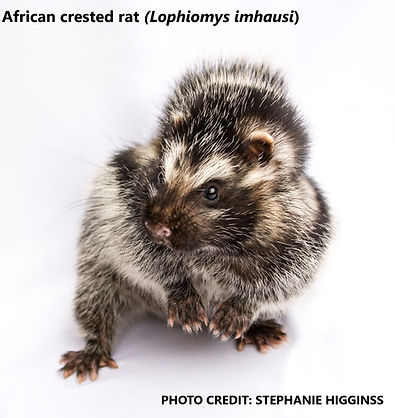
African crested rat/ poisonous rat: only mammal known to sequester plant toxins for chemical defense
-
African spiny mice (Acomys): only mammal known to tear off its skin and regrow it completely without a scar in order to escape predators
Mammal Atlas Kenya (MAKENYA) project
Anybody can be a naturalist, if one has passion for nature. The MAKENYA | Mammal Atlas Kenya project is a mobile based application, which enables naturalists to report sightings of mammals during their expeditions. Such data is unavailable, but is valuable for conservation and mapping the distribution of Kenyan mammals. Through the Mammal Committee of Nature Kenya and Mammalogy Section of National Museums of Kenya, we help sensitize the public to download and submit their sightings through the MAKENYA mobile app.
Download and install MAKENYA app on your smartphone here. View the current records here.
